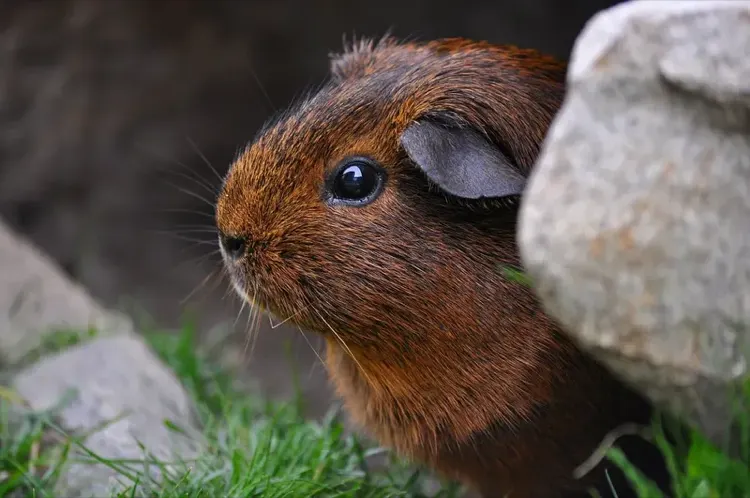

Have you ever wondered what your guinea pig actually sees when it looks at you? Their world doesn’t look the same as ours, and understanding their vision can help you create a better environment for them.
Can Guinea Pigs See Color?
Guinea pigs have two types of cones in their eyes, which let them see a range of colors. They won’t see every color as vividly as we do, though.
They often have trouble distinguishing between similar shades of green or blue.
These furry animals have dichromatic color vision, meaning they can only process two color channels. Humans have trichromatic vision, so we can process three.
One study found that guinea pigs could tell different colors apart, but they struggled with similar shades. This suggests their vision isn’t as sharp as ours, but they’re definitely not colorblind.
What Colors Can a Guinea Pig See?
Guinea pigs can see a range of colors, but greens, yellows, and blues are probably the easiest for them to distinguish from each other.
Red is another color guinea pigs can see, but it may not appear as bright to them as it does to us. All colors likely look a bit muted to a guinea pig.
White and black are also visible to them, though they may not perceive the contrast as strongly as we do.
What Colors Can’t a Guinea Pig See?
There are two colors a guinea pig can’t see properly: purple and pink. These fall outside of their color spectrum.
That doesn’t mean your guinea pig won’t notice a purple or pink object. It’ll see the object, but the color will appear differently.
A purple flower might look blue to a guinea pig because the purple light gets absorbed and only the blue light reflects back.
Are Guinea Pigs Blind in the Dark?
Guinea pigs are most active at dawn and dusk. Unlike many other animals, they don’t have good night vision.
If you’re curious about how they handle nighttime, check out our guide on whether guinea pigs can see in the dark.
Guinea pigs have other ways of navigating in the dark. They use their sense of smell to find food and water, and their hearing helps them avoid predators.
They can also feel vibrations through the ground, which helps them sense danger. So they’re not completely blind in the dark, but they rely heavily on their other senses to get around.
What Do We Know About Guinea Pig Vision?
Guinea pigs are perceptual creatures that engage all of their senses to understand their surroundings. Once you understand how they see the world, you can create a better environment for them.
Every guinea pig is nearsighted, meaning they can see things up close but not far away. That’s why their eyes are so large, giving them a wider field of view.
Their color vision isn’t as sharp as ours, but they can see a range of colors and they’re definitely not colorblind. They can’t see well in the dark, but their other senses pick up the slack.
What they lack in eyesight, they make up for in smell and hearing. Guinea pigs have incredible senses of smell and hearing, and they rely on these to understand their environment.
Since guinea pigs are crepuscular rather than nocturnal, their vision is best suited for dawn and dusk lighting.
How Do Guinea Pigs See Food?
Guinea pigs have very different eyesight from humans. Our vision relies on our eyeballs moving in their sockets to focus, but guinea pigs can’t do that.
Their eyeballs are static.
Instead, they have a transparent layer at the front of their eye called the cornea, which bends incoming light. This means guinea pigs see food best when it’s close to them.
Guinea pigs also have excellent peripheral vision. Because their eyes sit on the sides of their heads, they can see things that aren’t directly in front of them very well.
That’s useful for a prey animal watching out for threats.
Why Do Some Scientists Think Guinea Pigs Have Poor Eyesight?
It’s a fact that guinea pigs don’t have great eyesight. Their color vision isn’t as sharp as ours, and there are several anatomical reasons for this.
Their eyes are set far back on their head, making it hard to see anything up close. They also have poor depth perception, so judging distances accurately is a challenge.
All of these factors add up to relatively weak vision overall.
Common Guinea Pig Eye Problems
There are several eye problems that show up frequently in guinea pigs. One of the most common is conjunctivitis, an inflammation of the tissue around the eye.
This can come from a bacterial or viral infection, or from allergies.
Other common issues include corneal ulcers (sores on the eye’s surface) and glaucoma (a buildup of pressure in the eye). If you notice any changes in your guinea pig’s eyes, it’s worth learning about guinea pig eye infections and taking your pet to the vet for an evaluation.
How to Support Your Guinea Pig’s Vision
There are a few things you can do to help your guinea pig see better. First, make sure their cage sits in a well-lit area so they can see their surroundings clearly.
Second, provide plenty of toys and activities to keep them stimulated. This helps engage their senses and keeps their mind active.
Finally, avoid moving the cage too often. Frequent changes can disrupt their spatial memory and make it harder for them to orient themselves.
Providing a stable guinea pig hideout gives them a reliable safe spot they can always find.
Final Thoughts
Guinea pigs experience the world very differently than we do. Their dichromatic vision means colors look muted, and their nearsightedness limits what they can see at a distance.
But don’t feel sorry for them. Their wide peripheral vision, sharp hearing, and strong sense of smell more than make up for what their eyes can’t do.
If you want to help your piggy thrive, focus on a well-lit, stable environment with plenty of sensory enrichment. That matters far more to them than how many colors they can see.
References
- https://pubmed.ncbi.nlm.nih.gov/7826522/
- https://www.ncbi.nlm.nih.gov/pmc/articles/PMC7445358/
- https://iovs.arvojournals.org/article.aspx?articleid=2123700
- https://www.spandidos-publications.com/10.3892/etm.2011.341
- https://allanimalsfaq.com/pig/can-guinea-pigs-see-in-colour/
Frequently Asked Questions
Guinea pigs see best during daytime hours. Their eyes aren't designed for low-light conditions, so they rely on hearing, smell, and spatial memory to navigate after dark. Keeping their cage in a naturally lit room during the day supports their vision and overall comfort.
Guinea pigs can detect the flickering images on a TV screen, but they can't process the content the way humans do. The rapid motion and bright light changes might catch their attention briefly. However, they don't understand or enjoy watching TV like we do.
There's no single color that all guinea pigs prefer. Since they see greens, yellows, and blues most clearly, they might respond more to these shades in their environment. Try different colored toys and accessories to see what your specific piggy reacts to most.
Your guinea pig sees you as a large, somewhat blurry shape because they're nearsighted. Up close, they can make out more detail, which is why they often sniff and nuzzle your hand. They rely more on your scent and voice to recognize you than on sight alone.
Guinea pigs can lose their vision from cataracts, glaucoma, infections, or age-related conditions. Blind guinea pigs often adapt surprisingly well because they already depend heavily on smell, hearing, and spatial memory. Regular vet checkups can catch eye problems early before they progress to blindness.