
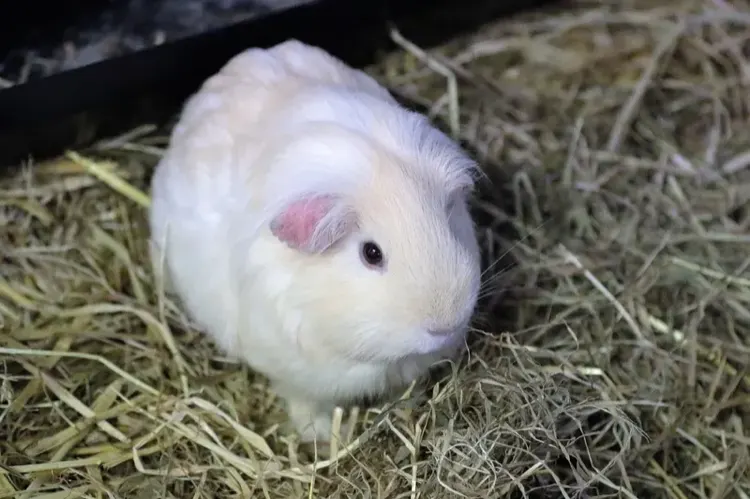
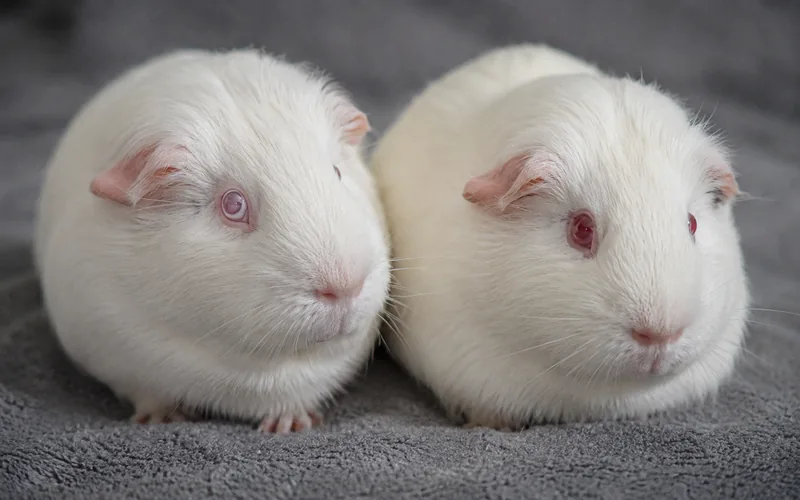
A white guinea pig with pink eyes almost always gets called an albino guinea pig. That label is usually wrong.
Three separate conditions can produce a white coat and pink eyes, and only one of them makes a true albino. A second is far more common, and a third is a serious birth defect covered further down.
This guide sorts out all three. You’ll learn what to check on your own piggy, whether weak eyesight comes with the coat, and what changes about daily care.
The news is good for most owners. A white guinea pig with pink eyes is usually healthy, and the rare cases that are not show clear signs early.
What Makes a Guinea Pig Albino
Albinism in guinea pigs is a genetic condition that stops the body from making melanin. Without melanin, fur grows in white and the skin holds no pigment at all.
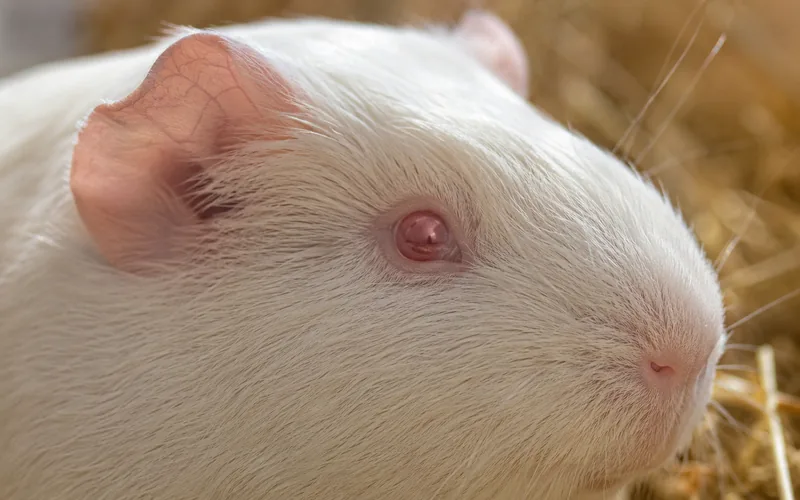
The eyes lose out too. With no color in the iris to mask the blood vessels behind it, the eye looks pink or red.
Guinea pigs are rodents, not pigs, despite the name. The species is Cavia porcellus, a South American rodent that people tamed around 5,000 B.C.
Domestication changed their coats a lot, and Animal Diversity Web at the University of Michigan counts 20 different phenotypes for hair color in the species.
Albinism sits at the far end of that range, where pigment stops completely rather than shifting to a lighter shade.
The mutation behind it affects one of the genes used to build melanin. That gene is recessive, so a guinea pig needs two copies before white fur and pink eyes appear.
Because the trait is recessive, two colored parents can carry it without showing it. A pair of ordinary brown or black guinea pigs sometimes produces one white baby in a colored litter.
Dominant coat genes work the other way. A single copy is enough to show, so most guinea pig colors pass down predictably.
Where Pigment Actually Comes From
Cells called melanocytes make melanin, and they sit in the skin, the hair follicles, and the eyes.
Melanocytes need a working set of genes to build pigment, and if one fails, the color never appears.
In a true albino the melanocytes are there, but they can’t finish making the pigment.
This is why albinism affects more than fur. Skin and eye tissue lose pigment together, because the same cells supply all three.
Albino vs. Pink-Eyed White: What Most Owners Get Wrong
In simple terms, a true albino makes no pigment anywhere, while a pink-eyed white makes it everywhere except the coat.
A pink-eyed white guinea pig, usually shortened to PEW, looks nearly identical to an albino. White coat, pink eyes, same first impression across the room.
The genetics differ, though, because a pink-eyed white carries a coat color gene that switches pigment off in the fur.
That animal still makes melanin in other tissues. Its skin, ears, or foot pads often keep a faint grey or brown tint that a true albino never has.
Here’s the part that trips people up: longtime keepers often insist that true albinism doesn’t exist in guinea pigs at all.
That claim is half right. Classic albinism is uncommon in pet guinea pigs, and most pink-eyed piggies people call albino are simply PEWs.
It does exist in laboratory lines, though. The Dunkin-Hartley strain is an albino guinea pig bred for research, with a smooth white coat and no pigment.
Albino rats fill the same role in other labs, and that pink-eyed white rat is the one most people picture.
Outside those research lines, the white guinea pigs sold as pets are almost always pink-eyed whites. Sellers rarely make the distinction, and buyers never learn there’s one.
How to Tell If a Guinea Pig Is Albino
You can’t confirm albinism from across a room, since albinos and pink-eyed whites look alike from a distance.
Checking a few spots up close narrows it down. Look at the skin under the fur, the ear interiors, and the foot pads in natural light.
| What to check | True albino | Pink-eyed white |
|---|---|---|
| Skin pigment | None anywhere, evenly pale pink | Faint grey or darker patches possible |
| Ear interior | Uniformly pale pink | Pale pink, sometimes lightly speckled |
| Foot pads | Pale pink throughout | Pale pink, occasional darker spots |
| Coat | Pure white with no cream tones | White, sometimes a faint cream cast |
| Pigment elsewhere | Cannot make melanin at all | Makes melanin, just not in the coat |
A DNA test through a vet or a registered breeder is the only way to know for certain.
What’s the bottom line? Treat the albino label as a rough description rather than a diagnosis.
Check during daylight near a window rather than under a warm bulb, which tints pale skin.
Damp fur reveals the skin better than dry fur.
Parent history tells you more than any inspection. Ask a breeder what both parents looked like, and their coat colors will narrow it down fast.
Age changes what these checks tell you. A Himalayan baby is born white and grows dark points later, so a young white piggy can fool you.
Are Albino Guinea Pigs Blind?
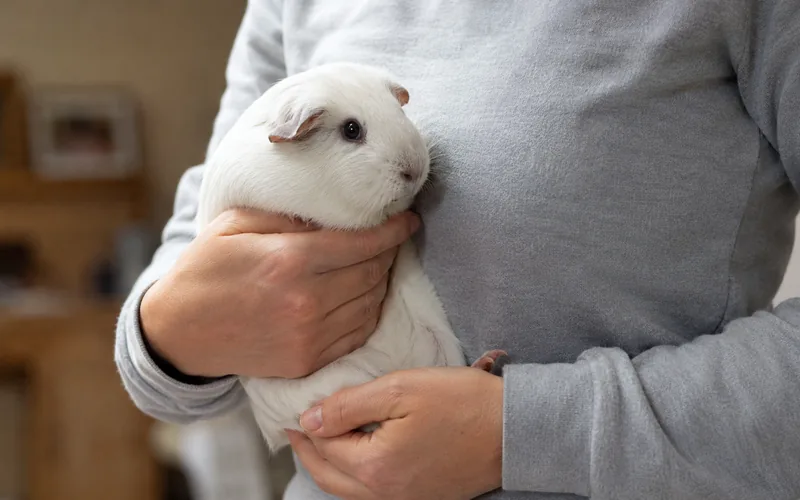
Albino guinea pigs are not blind, though their eyesight is weaker than average. Melanin helps the eye develop and soaks up stray light.
An eye without that pigment works less precisely, so bright rooms wash out contrast and depth judgment suffers.
A white piggy may squint under a lamp, or pause before a short hop it can’t measure well.
Guinea pigs don’t rely much on sight anyway. They find their way by smell, hearing, and the long whiskers on the face.
Mild vision loss barely slows them down, and even a blind guinea pig navigates a familiar cage with confidence.
Bright light is worth managing, so keep the cage out of direct sunlight and add a shaded hideout.
An unpigmented eye has no natural filter against glare. A piggy that hides all day in a sunny room is telling you the light is too strong.
People ask about hearing too. Deafness is not part of albinism in guinea pigs, unlike the pigment-linked deafness seen in some white cats and dogs.
Steady pink eyes are just the coat genetics showing through. Sudden redness, swelling, or discharge is a different matter.
Those signs can point to infection, injury, or a scratched cornea, and each needs a vet rather than a shade cloth.
Lethal White Guinea Pigs Are Not the Same Thing
In short, this condition is not a form of albinism. It is a birth defect, and the white coat is only the visible sign.
Lethal white syndrome gets confused with albinism constantly, and that confusion matters. A lethal white guinea pig is also white with pink eyes.
The condition comes from breeding, not from a pigment gene.
The Royal Veterinary College explains that it appears when two roan or two dalmatian coated guinea pigs are bred together. Neither coat pattern carries risk on its own.
The same factsheet gives the odds: that pairing leaves each baby with a 25% chance of inheriting the lethal white gene.
Other siblings in the same litter can be perfectly healthy, and coat pattern alone doesn’t tell you which babies are affected.
What this means for you: ask any breeder what both parents looked like before you bring a white baby home.
Affected babies are born white with pink eyes and much smaller than their littermates, and most are blind and deaf from birth.
The Royal Veterinary College factsheet lists these birth defects in affected piggies:
- Microphthalmia, meaning small or absent eyes, along with blindness
- Deafness
- Malformed teeth front and back, often with missing front incisors
- Stunted growth and physical deformities
- Neurological signs
- Gastrointestinal disorders
- Poor immunity
A lethal white guinea pig may live only a few months, and rarely reaches more than a couple of years.
Caring for one is a serious commitment, since these pets need a single level cage with an unchanging layout.
A calm companion helps them settle and feel safe, while weekly weight checks and regular dental exams finish the routine.

Animal welfare guidance is clear: pairing a roan or dalmatian with a solid colored mate removes the risk entirely.
Roan and dalmatian patterns are perfectly healthy coats to own, and the danger appears only when two of them are bred to each other.
Health Problems and Life Expectancy
A healthy albino or pink-eyed white guinea pig lives as long as any other piggy. The ASPCA puts a typical guinea pig lifespan at 5 to 7 years with proper care.
White coats bring two small extra concerns. Sun sensitivity is the first, because unpigmented skin burns easily through thin fur on the ears and nose.
Shade solves most of that problem, and a hideout, a partly covered cage, and no direct window sun are enough.
Sunburn looks like pink, flaky skin along the ear edges and across the nose. Move the cage before it gets that far, since sunscreen isn’t safe for a piggy to lick off.
The second concern works in your favor, since dirt, urine staining, and early skin problems all show up faster on white fur.
You end up catching trouble sooner, and mites, fungal patches, and small wounds are all easier to see on a pale coat.
Teeth deserve steady attention in every guinea pig, and the same Animal Diversity Web account records 20 teeth that grow continuously through life.
Grinding on hay keeps those teeth worn down, and overgrown teeth cause weight loss fast, since eating turns painful.
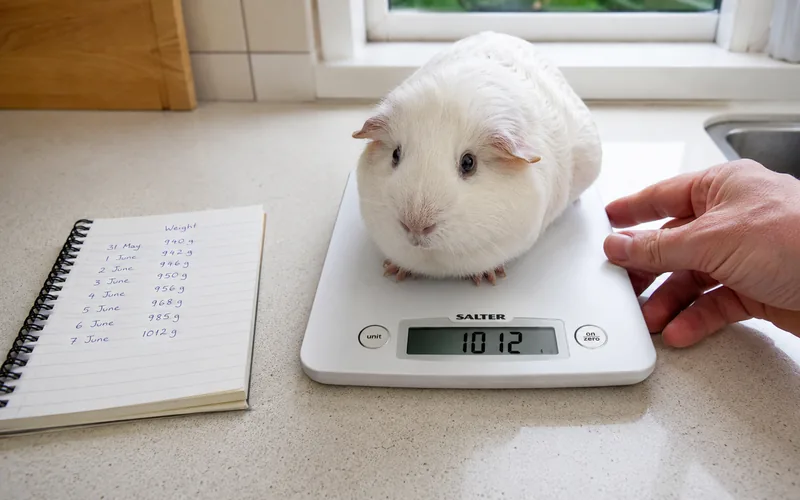
The short version: Weigh your piggy weekly and book a vet visit if the number drops two weeks running.
Vitamin C is the other constant across every coat color. Guinea pigs can’t make their own, so scurvy becomes a real risk.
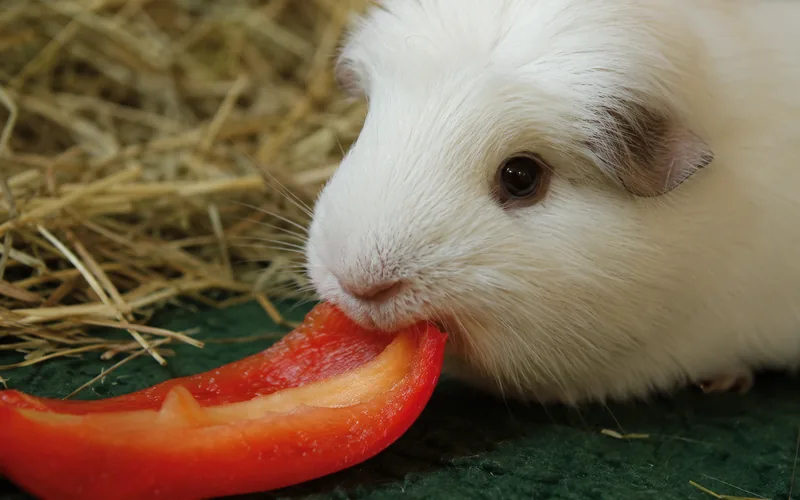
Fresh vegetables cover most of that need, and bell peppers, parsley, and leafy greens are reliable sources. Vitamin-added pellets cover the rest.
Gastrointestinal disorders are the last common problem worth naming. A guinea pig that stops eating needs a vet the same day, whatever its color.
Caring for an Albino Guinea Pig
Daily care for an albino guinea pig follows the same rules as for any other piggy. Six essentials cover nearly all of it:
- Unlimited hay, the bulk of the diet and available day and night
- Fresh vegetables every day for vitamin C
- Quality pellets, vitamin-added and measured out daily
- Clean water, checked and refilled daily
- A large cage, kept away from windows and direct sun
- At least one companion, since guinea pigs are herd animals
Lighting is the one real adjustment for a white coat.
A covered hideout gives your piggy somewhere to go when the room gets bright. Most white piggies use one more than darker guinea pigs do.
Change how you handle them, too. A guinea pig with weaker eyesight startles more easily, so speak before you reach into the cage.
Bedding is worth a second thought with white fur. Dust-free paper bedding stays clean and won’t stain the coat the way wood shavings can.
Grooming stays simple for short-haired piggies, so a weekly brush is plenty, and the American guinea pig coat asks for nothing more.
It gets better: white fur makes routine health checks easier, not harder.
Run your hands over the body weekly, when scabs, bald patches, and lumps all stand out against a pale coat.
Settling a New Albino Guinea Pig In
A new guinea pig needs time before it acts like itself, and many keepers follow the 3-3-3 rule for that stretch.
The first three days are for decompressing, so your piggy will hide, eat little, and freeze when you walk past the cage.
Leave it alone during those days, since fresh hay, water, and a quiet room do more good than handling.
The next three weeks are for learning the routine, and your guinea pig starts recognizing your voice, footsteps, and feeding times.
Appetite returns to normal here, and popcorning and wheeking usually appear once the piggy feels safe.
By three months, most guinea pigs are fully settled. Personality shows, and the pet treats the cage as home rather than shelter.
The same timeline holds for a white piggy, with one small adjustment. Keep the room dim for the first few days, when weaker eyesight makes bright light extra stressful.
Introducing a companion works best after that first week. A piggy that already knows its cage handles a new cagemate with far less stress.
Neutral ground makes introductions go more smoothly. Set both guinea pigs in a spare pen or cleared space neither has claimed, and let them work out their ranking.
Are Albino Guinea Pigs Rare?
True albino guinea pigs are rare as pets, but white guinea pigs with pink eyes are not. Pink-eyed whites turn up regularly in litters, pet stores, and rescues.
Genuine albino lines stay mostly inside research colonies and university breeding programs.
Where Can You Buy an Albino Guinea Pig?
Breeders and rescues are the two realistic sources, since a pet shop white piggy is almost always a pink-eyed white. Sellers list them often, usually under the albino label.
Price rarely reflects that rarity, and a white piggy costs about the same as any other color.
A seller charging extra for a rare albino is nearly always selling a PEW. That premium buys you nothing the pet doesn’t already have.
To buy a white piggy safely, ask the right questions before you pay. A responsible breeder will name both parents’ coat patterns without hesitating.
Skip any seller who can’t answer that, especially if either parent was roan or dalmatian.
Check rescues before breeders, since white guinea pigs show up in shelters often and adopting avoids the breeding questions.
What Is the Rarest Color of Guinea Pig?
The truly rare coats aren’t white at all. Solid chocolate and lilac are harder to produce evenly, because one stray pigment patch disqualifies a show animal.
A Himalayan guinea pig starts life white before its dark points develop, and room temperature affects how those markings turn out.
Final Thoughts
Most white guinea pigs with pink eyes are pink-eyed whites rather than true albinos. Both live full, healthy lives, and the genetics differ more than the care does.
The condition worth knowing is lethal white syndrome, which comes from breeding two roan or two dalmatian parents. Its signs appear at birth, severe enough that nobody mistakes a healthy PEW for one.
Give a white piggy shade, a companion, unlimited hay, and a yearly vet visit. That covers everything the coat color changes.
Frequently Asked Questions
White guinea pigs are not rare at all. Pink-eyed whites appear regularly in litters, in pet stores, and in rescues. What is genuinely rare is true albinism, which means the animal cannot make melanin anywhere in its body. Most white piggies sold as albinos are pink-eyed whites, and they cost about the same as any other color.
The 3-3-3 rule describes how a new guinea pig settles in. The first 3 days are for decompressing, when the piggy hides and eats little. The next 3 weeks are for learning the routine and recognizing your voice. By 3 months, most guinea pigs feel at home and show their full personality. Coat color makes no difference to this timeline.
Solid chocolate, lilac, and true roan coats are among the hardest colors to produce consistently. White is not rare, despite how striking it looks. Breeders find solid, evenly distributed dark colors more difficult to achieve than white, because any stray pigment patch disqualifies a show animal.
Check the skin under the fur, the inside of the ears, and the foot pads in good light. A true albino has no pigment anywhere, so every patch of skin looks uniformly pale pink. A pink-eyed white may show faint grey or darker patches. A DNA test through a vet or breeder is the only way to confirm it for certain.